Napoleon and Joséphine in Paris: Love Letters, a Crown and Malmaison
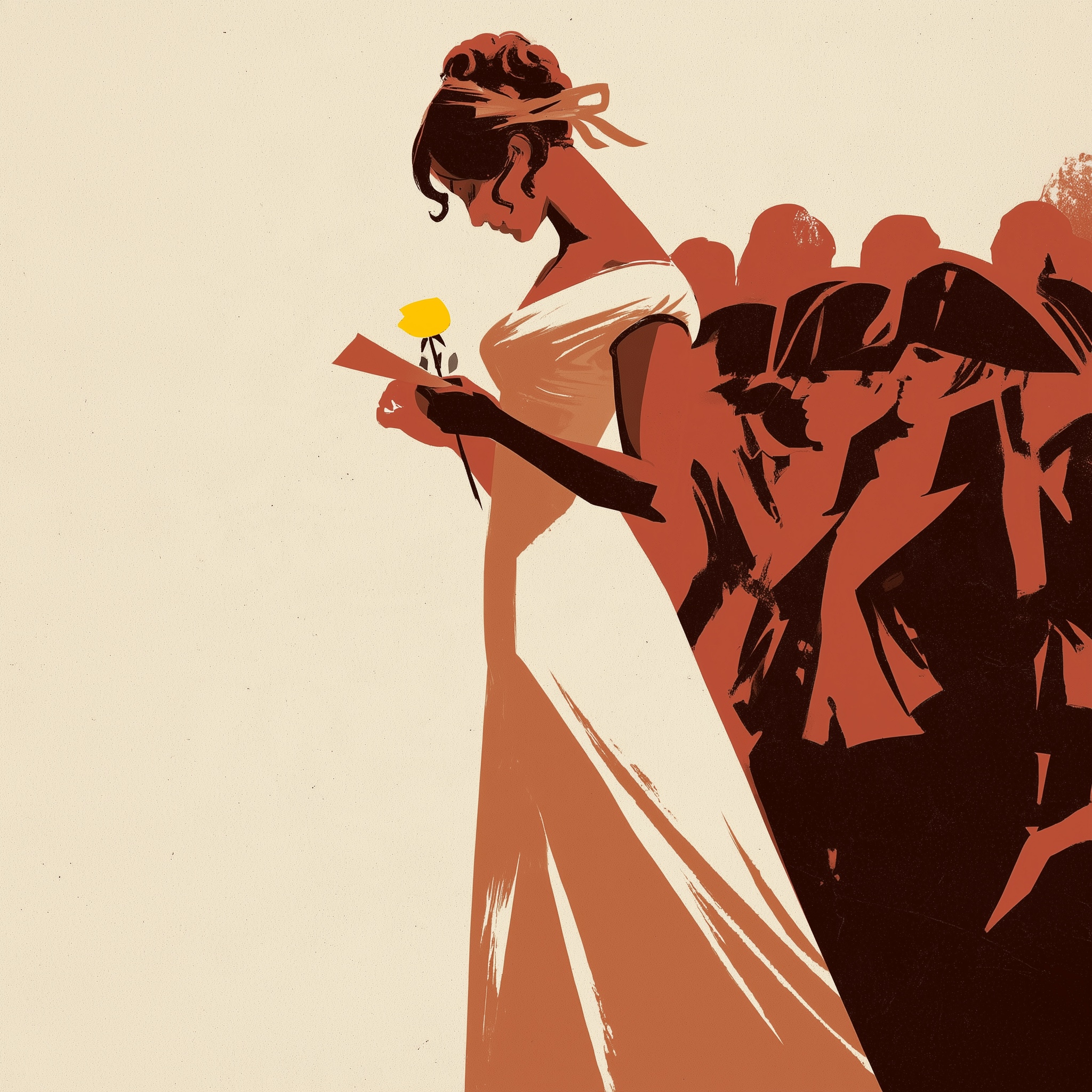
In the autumn of 1795, Rose de Beauharnais, survivor of the Terror and one of the queens of Directory Paris, meets a thin, intense general six years younger than she is. Her story before him is in Joséphine Before Napoleon. He falls hard. She falls much more slowly, because for her, at first, this is a marriage of business. He renames her Joséphine, from her middle name, the way he would later rename streets.
The wedding
They marry on 9 March 1796 at the town hall on rue d'Antin. She arrives at eight in the evening; he arrives at ten, buried in maps, since he leaves for Italy two days later. The certificate is a work of fiction. She takes four years off her age, he adds a little more than one to his, he gives the town hall itself as his address, and one of the witnesses is too young to be a legal witness at all. None of it mattered. They spent their wedding night on rue Chantereine.
A letter a day
Then he is gone, and the letters begin. From March to July 1796, in the middle of an insane campaign in which he wins one battle after another, Bonaparte writes to her every single day. "Nature made me with a strong and determined soul," he writes from Nice. "She built you of lace and gauze."
Some of them are far less poetic. In one he sends her kisses "everywhere, everywhere", which in 1796, and frankly today, leaves very little to the imagination. What makes me laugh is where that letter lives now: at the Archives nationales, in the Marais, behind armored glass, guarded like the Holy Grail, when it is one of the most intimate and openly erotic things a man ever sent through the army post.
She answers now and then, sometimes rather flatly, and it wounds him badly. What interests her for the moment is shining in Paris society, and she is seen all over town with a dashing young hussar officer named Hippolyte Charles. The rumors reach Italy, and Bonaparte goes half mad with jealousy.
Notre Dame, 2 December 1804
Eight years later, in Notre Dame, the Pope has come from Rome to bless an emperor. Napoleon crowns himself, then turns, and Joséphine kneels, and he places the crown on her head. David painted the moment on a canvas so large the Louvre had to give it a wall of its own. Look at her face. She is smiling with her lips closed. Her teeth, damaged since a childhood spent chewing sugar cane in Martinique, were bad, and she had learned to smile without showing them.
The English muslin
She loved dresses, jewels, gardens and credit, roughly in that order. Napoleon spent years paying her dressmakers, and she spent the same years hiring new ones. I sometimes wonder whether all that buying was also a way of filling the hole the Terror had left in her.
Her finest act of rebellion came after 1806, when Napoleon closed the whole continent to English goods. Joséphine could not resist the best English fabrics, bought under the counter, and she would sweep into official receptions in sumptuous gowns while everyone in the room knew exactly where the cloth had come from. For the man enforcing the blockade it was a public humiliation, and it led to some legendary rows.
Malmaison, the divorce, the roses
What she could not give him was an heir. On 15 December 1809, at the Tuileries, they divorce in a ceremony where both of them weep. She keeps the title of empress, a fortune, and Malmaison, west of Paris.
She had bought it herself, in April 1799, while he was in Egypt and without asking him: 325,000 francs, an absolute fortune, counting on the money she expected him to bring home. He came back furious. Then he paid, for years. As always, she lived far beyond her means, or rather far beyond his.
Go and see it. Malmaison is pure Empire, gilt and swans and eagles everywhere, the taste of people who had just arrived, which is exactly what they were. They both came from islands, from noble families with more titles than money, from childhoods that had not been easy, and I think that is what held them together for so long: they understood each other. They needed splendor to reassure themselves.
What I love most there, though, is not the gilt but the land around it. She was passionate about botany and nature, and she turned the estate into a living collection: hundreds of varieties of roses, black swans, kangaroos, a flock of more than five hundred merino sheep whose wool was meant to clothe the army. After a trip to Switzerland in 1810 she decided Swiss dairy was superior to anything in France, and had Swiss cows brought to Malmaison, along with a farming couple from Bern to look after them. As a Swiss, I can only approve. Rose, again, in the end. The name always finds its way back.
She died there in May 1814. On Saint Helena, by most accounts, one of the last words Napoleon spoke was her name, the one he had given her.
We follow the beginning of their story, the part before the legend, on the Napoleon Food Tour in Le Marais.
Quick answers
Where did Napoleon and Joséphine get married?
At the town hall of the second arrondissement, in the Hôtel de Mondragon, 3 rue d'Antin, on 9 March 1796.
How often did Napoleon write to Joséphine?
During the first Italian campaign, from March to July 1796, he wrote to her every day.
Where did Joséphine live in Paris?
On rue Chantereine (today rue de la Victoire), then at the Luxembourg and the Tuileries, before retiring to Malmaison after the divorce.
Come hungry. Leave with stories.
Private food and history tours in Paris. Your party only, three hours, with Mathieu.