How to Eat Paris in One Day
You have one day. Just one. Maybe it's your last day in Paris. Maybe it's the only one you dedicated to food because the rest of the trip was swallowed by the Louvre, Versailles, and that Seine cruise your mother in law absolutely insisted on, and from which you remember nothing but the wind in your hair and an audio commentary nobody was listening to. Doesn't matter. You have 12 hours ahead of you and you want this to be the day you're still talking about in five years.
Here's the paradox: the best way to plan this day is to not plan it too much.
9 AM: the market, empty stomach, eyes wide open
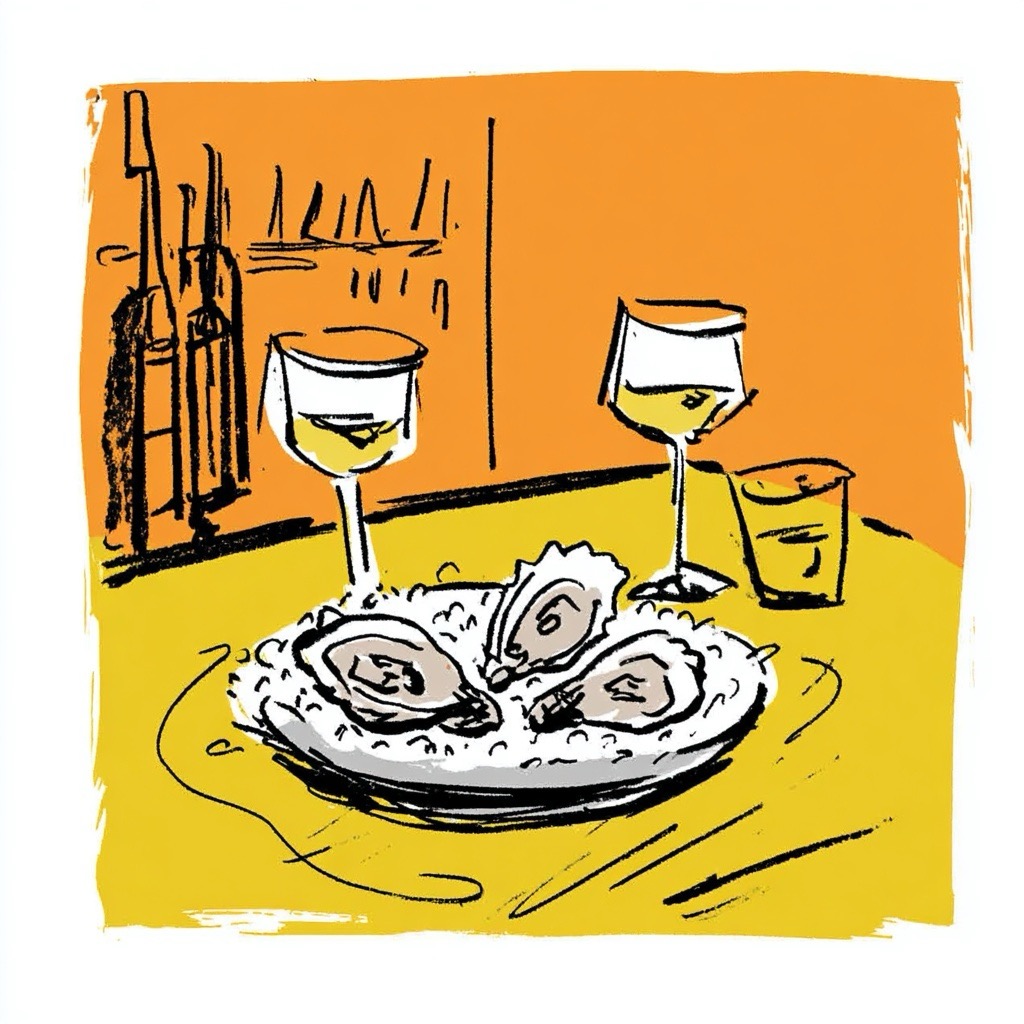
Don't start with a croissant. Start with a market. And start the market with a few oysters and a glass of bone dry white wine at the shucker's counter, standing up, before the morning crowd settles in. If you think that's excessive, you haven't switched to Parisian mode yet. Three oysters and a Muscadet before 10 AM doesn't make you an alcoholic. It makes you someone who has understood that the day is going to be beautiful and that it should be started accordingly.
Then walk through the aisles. Look. Not at the labels. At the colors. What's shining? What's overflowing from the crates? What has the farmer placed front and center, on full display, with the pride of a man who knows that this morning his product is unbeatable? That's seasonality. Not a concept. A visual spectacle. In April, it's the peas and asparagus that explode. In October, the mushrooms and squash. In June, the cherries that stare at you and know you're not going to resist.
Ask the farmer what's in season. He'll love that you asked. Parisians know by instinct, tourists never ask, and it's exactly that question that turns a purchase into a conversation and a merchant into an ally.
Seasonality is not poetry. It's logic. A seasonal product didn't fly in from Chile. It didn't grow in a gas heated greenhouse. It ripened in a field, in the sun, at its own pace. And that pace gives it two things nothing can replace: flavor and nutrients.
A seasonal pea eaten in April and a frozen pea eaten in November are the same word but not the same world.
And your palate knows it, even if your brain has forgotten.
And it's not just about vegetables. Fish has its seasons. Meat has its seasons. Cheese, obviously, has its seasons. A fresh goat cheese in spring and a fresh goat cheese in December don't tell the same story because the quality of the milk is not the same. Everything is connected. Everything holds together. And it's this natural coherence that makes French gastronomy so profoundly logical once you start to understand it.
10:30 AM: the baker, but the right one
Now, the croissant. But not just any. Not the one from the hotel café that was delivered in plastic at 5 AM. The one from an artisan who gets up at 2 and whose butter comes from a farm he can name. The difference between an industrial croissant and an artisanal croissant is the difference between hearing a song on a phone and hearing it in a cathedral. Same song. Not at all the same experience.
How to find it? Watch the line. If eight Parisians are waiting on a Tuesday morning, you've found it. Parisians don't stand in line out of politeness. They never do anything out of politeness. They stand in line because it's worth it.
12:30 PM: the bistrot and the proof on the plate
Sit down in a bistrot. Not a gastronomic restaurant. A bistrot. The one with the paper tablecloth, the waiter who doesn't smile but knows the menu by heart, and the daily special written in chalk on the board.
And then, look at the board. The peas you saw at the market? They're there, on the board, as a side for the daily special. The asparagus the farmer was proudly stacking this morning? Here they are, as a starter, with a vinaigrette and a soft boiled egg. This is not a coincidence. This is the system. The chef went shopping at the same market as you. The market decides. The chef executes. The plate tells the season.
This is Parisian gastronomy in its purest form. Not a menu frozen twelve months a year. A permanent dialogue between what nature offers and what the cook makes of it. And when you understand this, when you see the direct link between the morning stall and the midday plate, something shifts. The plate stops being food and becomes a record of the day itself.
Have some wine. A glass. At lunch. Ask the waiter what he recommends with the dish. If he shrugs, change bistrots. If he asks you a question back, settle in comfortably. You're in the right place.
3 PM: follow the day, not the plan
In the afternoon, put your itinerary away. The best food day in Paris is not the one you planned. It's the one that built itself, stop by stop, discovery by discovery.
But aimlessness without method is just wandering. So here is the method: walk one neighborhood, not three. Choose Le Marais, Saint Germain, or the streets behind Rue des Martyrs, and stay there. The artisans you're looking for cluster. They have always clustered. The cheesemonger is rarely more than 200 meters from the chocolatier, who is rarely more than 200 meters from the wine cellar.
You pass a cheesemonger whose window stops you? Go in. Ask what's at its peak right now. A chocolatier whose workshop smells of roasted cocoa from the sidewalk? Push the door. Ask what he made this morning. A wine cellar whose front promises 400 bottles and a man who wants to tell you about every single one? Sit down on the stool he'll inevitably offer.
The seasonality you learned in the morning applies here too. The cheesemonger will point you to the wheels at their peak. The wine merchant will pour you something that speaks to the season. The chocolatier will mention which beans he received this month. Everything is connected. The morning market, the midday bistrot, the afternoon artisan: this isn't a list of activities. It's a coherent narrative whose script is written by nature.
The problem, obviously, is that you don't know which doors to push. Paris has hundreds of artisans and you don't have thirty years of local experience to tell the excellent from the merely fine. The cheesemonger with three Best of Paris awards on the wall is often less interesting than the one with no award and an 80 year old grandmother running the till. You can't know that from the sidewalk. This is where a food tour changes everything: someone who has spent decades mapping these treasures takes you straight to the right doors, at the right time, with the right story.
8 PM: dinner as a conclusion
You've spent the day eating, tasting, understanding. Dinner is no longer just a meal. It's the conclusion of everything you've learned. You no longer order blindly. You know what good bread is. You know why cheese is served before dessert and not the other way around. You know how to ask the sommelier a question without blushing. And when you see "peas" on the menu, you smile because you saw them this morning in the farmer's hand and the circle is complete.
The perfect food day in Paris doesn't end with fireworks. It ends with a quiet moment. A table. A bottle. The calm certainty that you've understood something about this city that most tourists never understand.
The bottom line
Paris cannot be eaten in one day. But one well built day can teach you how to eat Paris for the rest of your life. The market teaches you the raw material. The baker teaches you the craft. The bistrot teaches you the connection between the earth and the plate. The artisan teaches you the passion. The wine merchant teaches you taste. And dinner teaches you that all of it forms a whole, an entire civilization organized around a single idea: eating is not feeding yourself. It's listening to nature, respecting its rhythm, and transforming what it offers into something beautiful.
The French spent centuries building this idea. You have one day to understand it. That's enough. As long as you start with the oysters.
Come hungry. Leave with stories.
Private food and history tours in Paris. Your party only, three hours, with Mathieu.